The Best System Is Rarely the Most Complex
There's a common belief in the software industry: The more features and technologies a system has, the better it must be. In reality, that's rarely true.
There's a common belief in the software industry:
The more features and technologies a system has, the better it must be.
In reality, that's rarely true.
The best system isn't the one that can do everything. It's the one that solves the business problem, keeps working five years from now, and can be maintained by your own team without requiring specialists for every small change.
Complexity Has a Cost
Every technology added to a project creates a new responsibility.
A new framework must be learned.
A new library must be updated.
A new architectural pattern increases the onboarding time for every developer who joins the company.
When a system depends on ten different technologies, finding engineers who understand all of them becomes increasingly difficult. And when a key developer leaves, much of that knowledge leaves with them.
That's when a "modern" architecture slowly becomes a maintenance problem.
Maintenance Costs More Than Development
The initial implementation is only a small fraction of a software's lifetime.
After the first release come years of:
- bug fixes;
- new features;
- business changes;
- performance improvements;
- security updates.
If every change requires days just to understand the architecture, the team isn't creating value anymore.
They're simply trying to understand the system itself.
Software Should Serve the Business
Software exists to solve business problems.
Customers don't buy React, Kubernetes, Micro Frontends, or the latest framework.
They buy a solution that works.
If two different architectures deliver the same business value, the better choice is usually the one that every developer on the team can understand within a few days.
A Practical Example of Simplicity
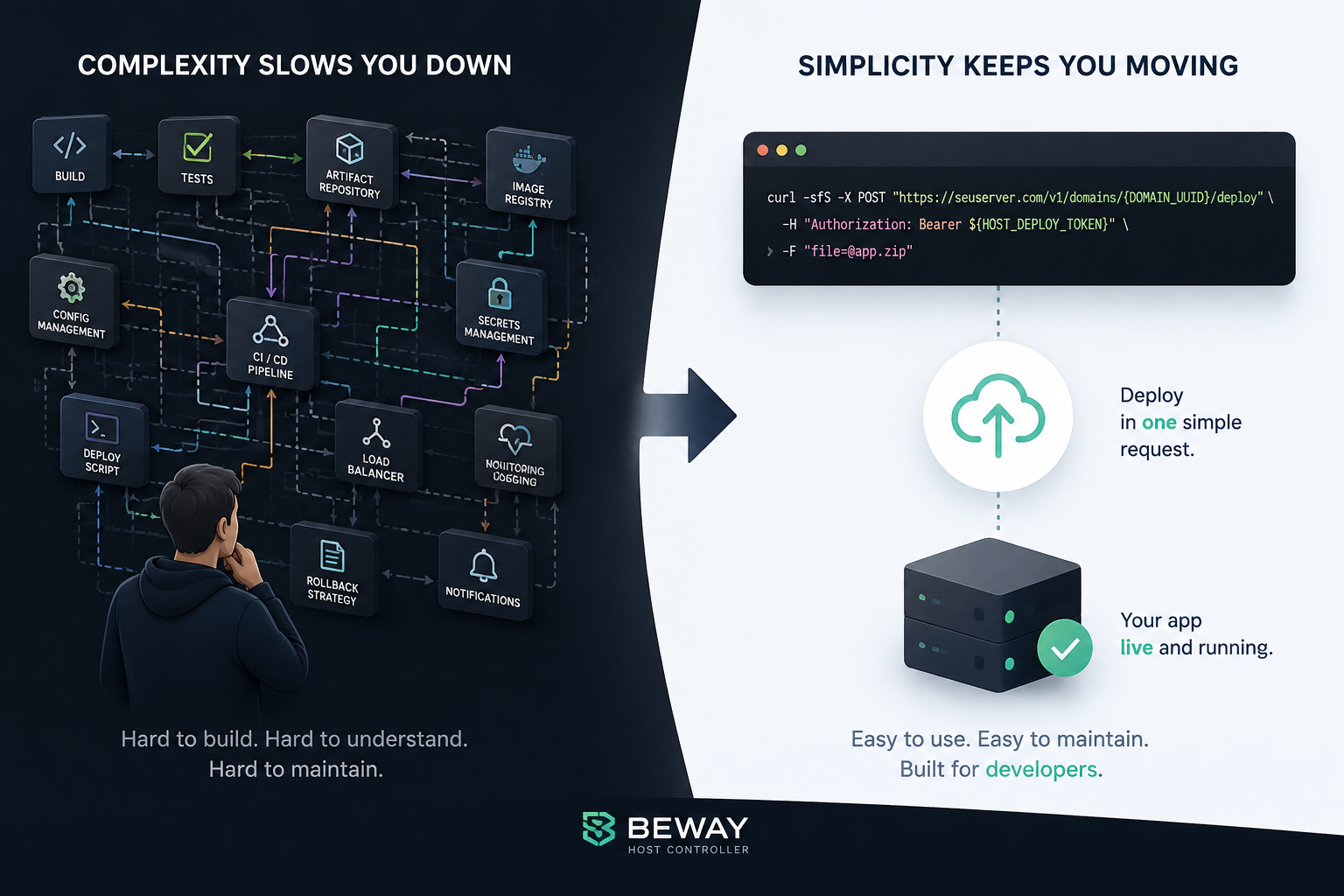
Recently, while designing a deployment platform, we discussed how publishing a new application version should work.
The first ideas sounded familiar: CI/CD pipelines, multiple integrations, infrastructure scripts, deployment agents, several configuration steps, and extensive documentation explaining how everything fit together.
Then someone asked a simple question:
"What are developers actually trying to accomplish?"
The answer was obvious.
They just want to deploy a new version of their application.
So why should every developer become an infrastructure expert just to perform a deployment?
A well-designed platform hides that complexity.
Instead of exposing every moving part, it provides a simple interface that anyone on the team can understand.
Deploying a new version becomes as simple as this:
curl -sfS -X POST "https://api.example.com/v1/domains/{DOMAIN_UUID}/deploy" \
  -H "Authorization: Bearer ${HOST_DEPLOY_TOKEN}" \
  -F "[email protected]"
That's it.
Behind this single request, the platform validates the package, uploads it, performs the deployment, restarts services if necessary, executes health checks, and handles everything else automatically.
Developers stay focused on building software.
Infrastructure engineers stay focused on improving the platform.
Everyone works at the right level of abstraction.
This philosophy inspired one of the ideas behind the Host Controller from Beway: infrastructure should reduce cognitive load, not increase it.
The best platforms aren't the ones that expose every capability.
They're the ones that make complex operations feel effortless.
Simplicity Scales Better
There's an old engineering saying:
"Anyone can build a complex system. It takes experience to build a simple one."
Designing something simple requires a deep understanding of the problem.
It means removing everything that doesn't create value.
Simple systems offer significant advantages:
- faster onboarding;
- lower maintenance costs;
- fewer failure points;
- easier hiring;
- faster long-term evolution.
The Most Powerful Architecture Isn't Always the Right One
Many companies try to copy the architectures used by the largest technology companies.
But very few have their scale, engineering budget, or operational challenges.
Building an overly sophisticated platform before you actually need it is like buying a semi-truck to carry your groceries home.
You'll have more capacity than necessary—and you'll pay for it every single day.
The Best Technology Is the One Your Team Understands
A team that deeply understands a straightforward technology stack often delivers far more value than a team working with dozens of tools they only partially master.
Productivity doesn't come from using more technologies.
It comes from delivering software quickly, safely, and consistently.
Final Thoughts
Before introducing another framework, another abstraction layer, or another service into your architecture, ask one simple question:
Will my team still be able to maintain this five years from now?
If the answer is "probably not" or even "maybe," the architecture is likely becoming more complex than necessary.
In the long run, successful companies aren't the ones with the most sophisticated systems.
They're the ones that continuously improve their products using code that people understand, platforms that empower developers, and technology that serves the business instead of getting in its way.
Because simplicity doesn't mean doing less.
It means putting complexity where it belongs.